How XRF Material Analyzers Enable Fast and Accurate Scrap Metal Identification

Transforming Scrap Sorting with Advanced Elemental Analysis
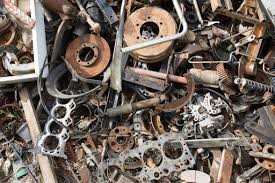
In the scrap metal recycling industry, speed and accuracy are critical. With rising demand for metal recovery and stricter quality requirements from smelters and manufacturers, recyclers can no longer rely on visual inspection or manual sorting alone.
This is where X-ray Fluorescence (XRF) material analyzers play a crucial role. XRF Material Analyzers provides fast, non-destructive, and highly accurate elemental analysis, making it one of the most powerful tools for scrap metal identification and sorting.
What Is XRF Technology?
X-ray Fluorescence (XRF) is an analytical technique used to determine the elemental composition of materials.
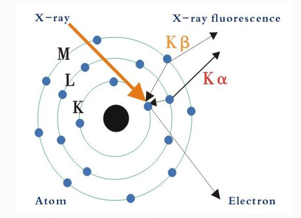
When a material is exposed to primary X-rays, its atoms become excited and emit secondary (fluorescent) X-rays. Each element emits energy at a unique signature, allowing the XRF material analyzer to identify and quantify the elements present in the sample.
In simple terms, XRF tells you what a metal is made of within seconds.
Why Scrap Metal Identification Is Challenging
Scrap metal yards and recycling facilities often deal with mixed and unknown materials. Identifying metals correctly is essential because even small classification errors can lead to:
- Lower material value
- Incorrect alloy sorting
- Failed smelting processes
- Customer disputes
- Financial losses
Common challenges include:
- Visually similar metals (e.g., stainless steel grades)
- Coated or painted surfaces
- Mixed alloy compositions
- Corroded or aged materials
- Lack of material documentation
Traditional methods like visual inspection or magnet testing are not sufficient for accurate alloy identification hence the XRF material analyzer is introduced for this purpose.
How XRF Material Analyzers Work in Scrap Sorting
XRF material analyzers provide instant elemental composition results on-site.
The process is simple:
- The operator points the XRF material analyzer at the metal sample.
- The device emits X-rays into the material.
- The sample emits characteristic fluorescent X-rays.
- The XRF material analyzer detects and interprets the energy signals.
- The result displays the elemental composition and alloy grade.
Within a few seconds, users can identify metals such as:
- Stainless steel grades (304, 316, 430, etc.)
- Aluminum alloys
- Copper and brass compositions
- Nickel-based alloys
- Precious metals (depending on model capability)
Key Advantages of XRF Material Analyzers
for Scrap Metal Identification
Fast On-Site Analysis
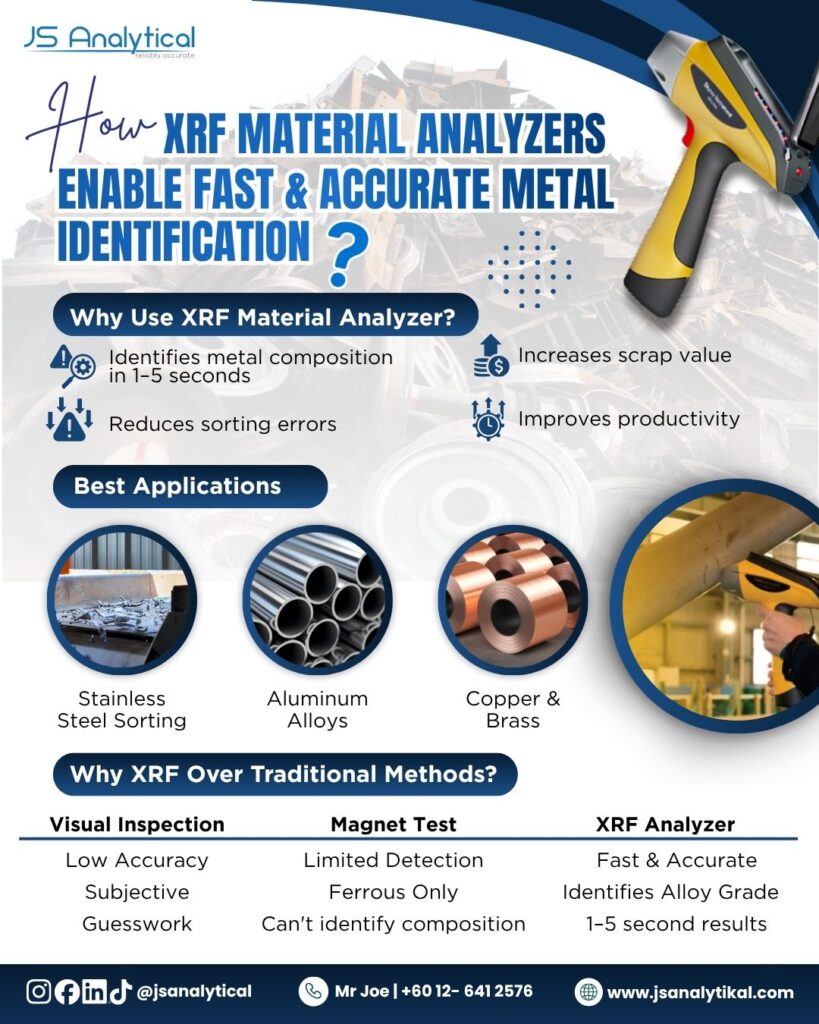
One of the biggest advantages of XRF Material Analyzers technology is speed. Results are typically available in 1–5 seconds, allowing operators to make immediate sorting decisions.
This significantly improves workflow efficiency in busy scrap yards.
High Identification Accuracy
XRF material analyzers provide precise elemental breakdowns, reducing the risk of misclassification.
For example, visually similar materials like stainless steel grades can be accurately distinguished based on chromium, nickel, and molybdenum content.
Non-Destructive Testing
XRF analysis does not damage or alter the sample. This is especially important when evaluating valuable scrap metals, where preserving material integrity is essential.
Wide Range of Detectable Elements
Modern XRF material analyzers can detect a broad range of elements, including:
- Transition metals
- Heavy metals
- Alloying elements
- Trace elements
This makes them suitable for diverse recycling applications.
Portable and Easy to Use
Handheld XRF material analyzers allow operators to perform analysis directly at the sorting site, whether in scrap yards, warehouses, or industrial facilities.
Minimal training is required, making the technology accessible to operational staff.
Applications in Scrap Metal Recycling
Stainless Steel Sorting
XRF Material Analyzer is widely used to distinguish between stainless steel grades such as 304 and 316, which have different nickel and molybdenum contents and significantly different market values.
Aluminum Alloy Identification
Different aluminum alloys have varying silicon, magnesium, and copper compositions. XRF Material Analyzer helps ensure correct classification for resale or reprocessing.
Copper and Brass Separation
Copper purity and zinc content in brass can be quickly determined, improving sorting accuracy and material value.
Precious Metal Analysis
Some XRF Material Analyzers are also capable of analyzing precious metals such as gold, silver, and platinum, making them useful in high-value recycling applications.
Improving Operational Efficiency with XRF Material Analyzers
By integrating XRF material analyzers into scrap metal operations, companies can achieve:
- Faster sorting cycles
- Reduced manual labor dependency
- Improved material valuation accuracy
- Better compliance with buyer specifications
- Lower risk of shipment rejection
This leads to more efficient and profitable recycling operations.
XRF Material Analyzer
vs
Traditional Scrap Identification Methods
| Method | Speed | Accuracy | Reliability | Limitations |
| Visual Inspection | Fast | Low | Low | Highly subjective |
| Magnet Test | Fast | Low–Medium | Limited | Cannot identify non-ferrous alloys |
| Chemical Test Kits | Slow | Medium | Moderate | Requires chemicals and sample prep |
| XRF Analysis | Very Fast | High | High | Initial equipment investment |
XRF Material Analyzers clearly provides the most balanced solution in terms of speed, accuracy, and usability.
Best Practices for Using XRF Material Analyzers
To ensure optimal performance, operators should:
- Calibrate the device regularly
- Clean sample surfaces before testing
- Avoid testing through coatings when possible
- Follow proper safety procedures
- Train operators for consistent measurement techniques
Proper usage ensures reliable and repeatable results.
Conclusion
XRF material analyzers have transformed the scrap metal recycling industry by providing fast, accurate, and non-destructive elemental analysis. With the ability to identify metal composition within seconds, recyclers can significantly improve sorting accuracy, reduce operational inefficiencies, and maximize material value.
As the demand for high-quality recycled materials continues to grow, XRF material analyzers are becoming an essential tool for modern scrap metal operations.
For companies aiming to improve efficiency and accuracy in metal identification, XRF material analyzers represent a powerful investment in both productivity and profitability.