Understanding Ferrous, Non-Ferrous, and Stainless-Steel Detection
Why Metal Classification Matters in Industrial Detection Systems
In food manufacturing, pharmaceuticals, packaging, and industrial processing, metal contamination is a serious concern. Even small metal fragments can damage equipment, compromise product safety, and lead to costly recalls.
To effectively control these risks, metal detection systems are designed to identify different types of metals, mainly ferrous, non-ferrous, and stainless steel. Understanding how these metals behave and how they are detected is essential for selecting and optimizing the right inspection system.
The Three Main Types of Metals in Detection
Metal detectors do not simply detect “metal” in general. Instead, they respond differently depending on the electrical conductivity and magnetic properties of each metal type.
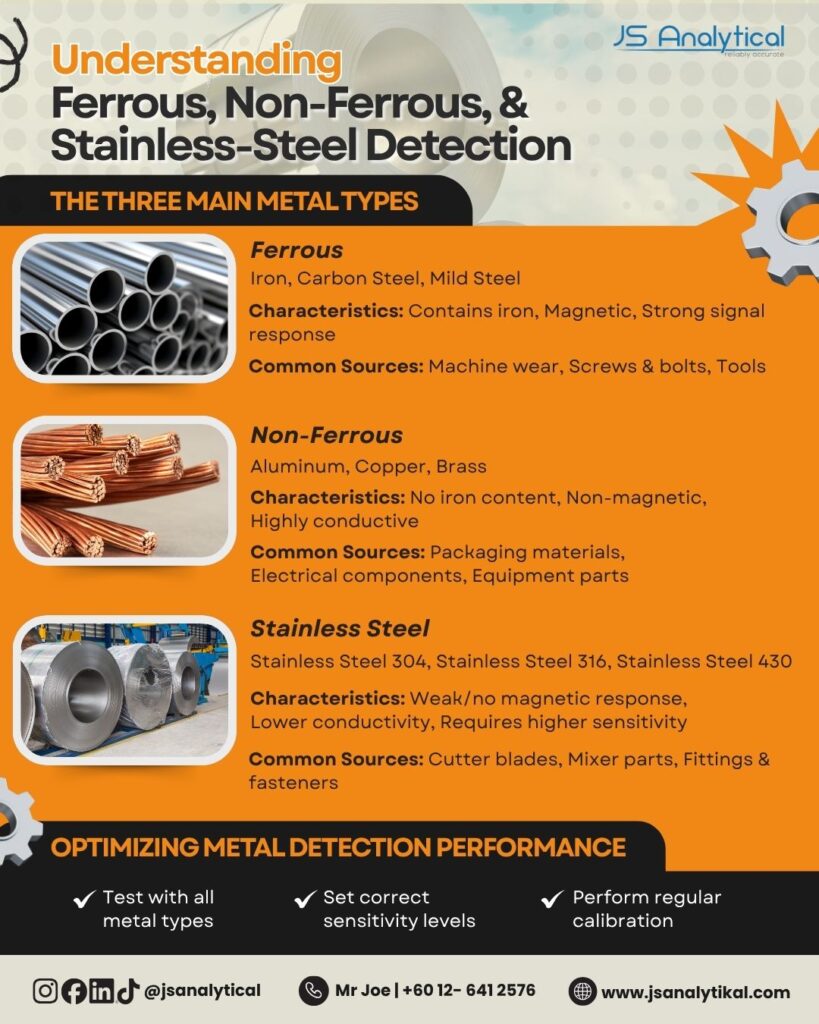
The three primary categories are:
Ferrous metals
Non-ferrous metals
Stainless steel metals
Each behaves differently when passing through a metal detection field.
Ferrous Metals
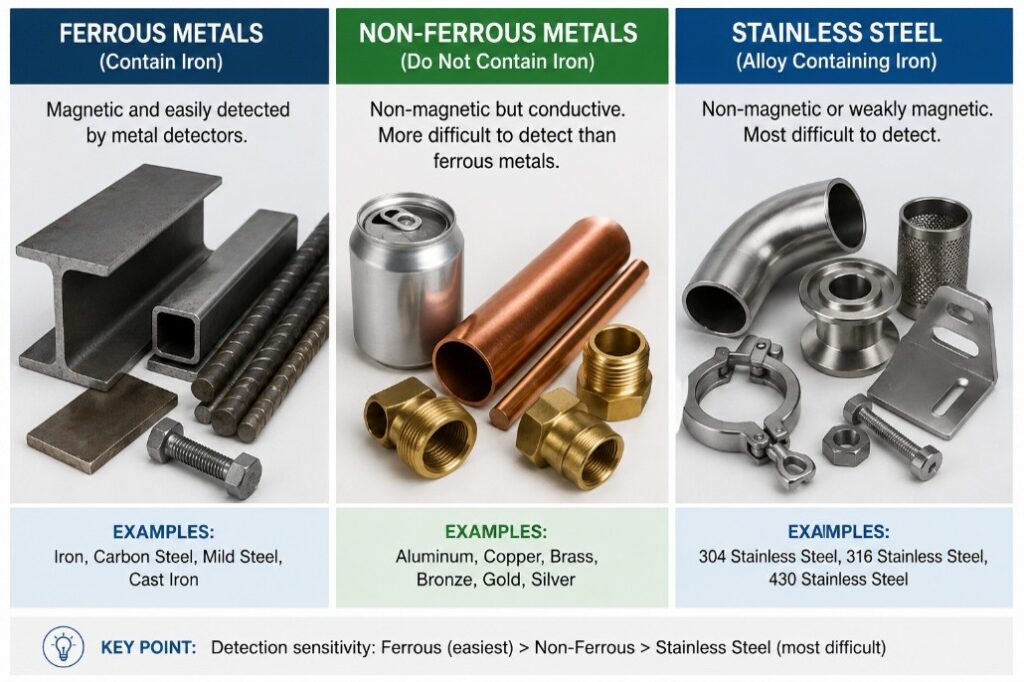
Ferrous metals are metals that contain iron. They are the easiest type of metal to detect using standard metal detection systems.
Examples of Ferrous Metals:
Iron
Carbon steel
Mild steel
Cast iron
Why Ferrous Metals Are Easy to Detect
Ferrous metals are strongly magnetic and conductive. When they pass through a metal detector’s electromagnetic field, they create a strong disturbance in the signal.
Because of this strong response:
Detection sensitivity is high
Even very small particles can be detected
Standard metal detectors can easily identify them
Industrial Risk of Ferrous Contamination
Ferrous contamination is common due to:
Machinery wear and tear
Broken equipment parts
Maintenance tools left in production zones
Even tiny fragments can pose serious risks to consumer safety and equipment damage.
Non-Ferrous Metals
Non-ferrous metals do not contain iron and are not magnetic. However, they are still conductive and can be detected by metal detection systems.
Examples of Non-Ferrous Metals:
Aluminum
Copper
Brass
Gold
Silver
Detection Characteristics
Non-ferrous metals generate a different type of signal response compared to ferrous metals. They are generally:
Less magnetic
Highly conductive
Slightly more challenging to detect than ferrous metals (depending on size and orientation)
Although less magnetic, these metals can still cause serious contamination issues and must be reliably detected in quality control systems.
Stainless Steel
Stainless steel is often the most challenging metal to detect in industrial applications.
Why Stainless Steel Is Difficult to Detect
Unlike ferrous metals, stainless steel is:
Non-magnetic or weakly magnetic (depending on grade)
Lower in electrical conductivity compared to other metals
Highly variable in detection response
This makes it less reactive in metal detection fields.
Common Stainless Steel Grades:
304 stainless steel
316 stainless steel
430 stainless steel
Among these, 304 and 316 are the most difficult to detect, especially in small particle sizes.
Sources of Stainless Steel Contamination
Stainless steel contamination typically comes from:
Worn conveyor parts
Broken machine components
Mixing equipment blades
Screws, bolts, and fittings
Because stainless steel is widely used in food-grade machinery, the risk of contamination is always present in production environments.
How Metal Detectors Differentiate Metals
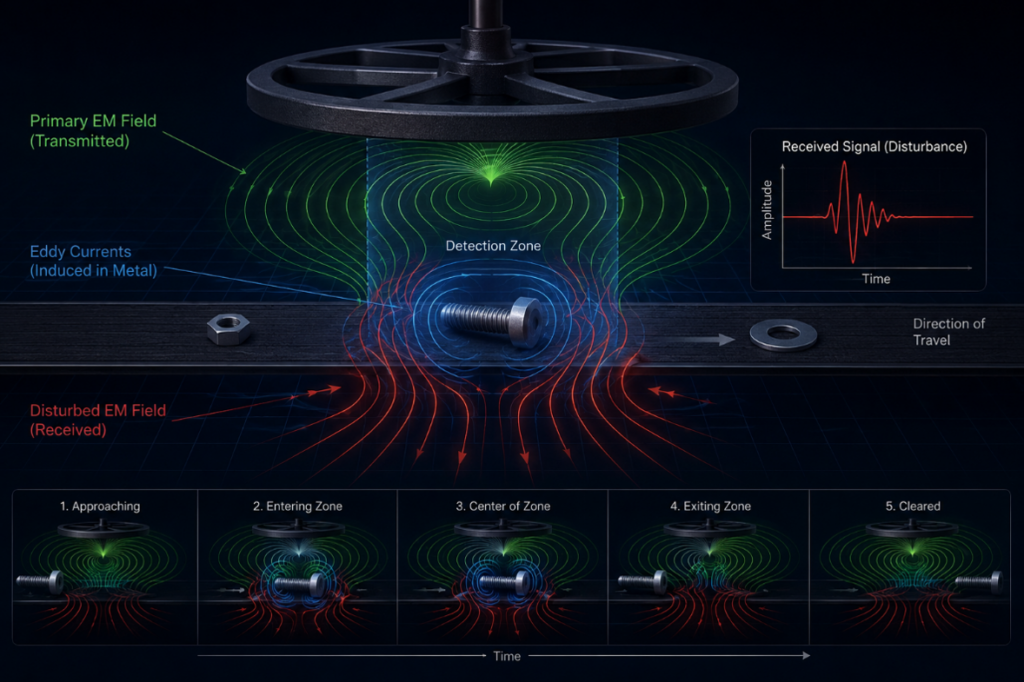
Metal detectors use electromagnetic fields to identify disturbances caused by metal objects passing through the detection zone.
The system analyzes:
Magnetic permeability (how a metal reacts to magnetic fields)
Electrical conductivity (how well a metal conducts electricity)
Signal phase response (how the signal changes when metal passes through)
By analyzing these factors, the system can detect and classify metal types indirectly, even if it does not explicitly “name” the metal.
Sensitivity Differences Between
Metal Types
If you are calibrating a system, you must design your quality control protocols around the baseline hierarchy of metal detection difficulty. In general, sensitivity performance ranks as follows:
Metal Type
Relative Sensitivity
Core Detection Mechanism
Ferrous
Easiest to Detect
High Magnetic Permeability + High Conductivity
Non-Ferrous
Moderate Difficulty
High Electrical Conductivity Only
Stainless Steel
Most Difficult
Weak/No Magnetism + Low Conductivity
Sources of Ferrous, Non-Ferrous,
and Stainless Steel Contamination
Ferrous contamination sources:
Broken machine parts
Screws and bolts
Conveyor belt wear
Tools left in production lines
Non-ferrous contamination sources:
Aluminum packaging
Copper wiring fragments
Brass fittings
Electrical components
Stainless steel contamination sources:
Mixer blades
Cutter knives
Worn stainless steel equipment
Fasteners and fittings
Understanding these sources helps optimize metal detector placement in production lines.
Optimizing Metal Detection Performance
To achieve reliable detection across all metal types, manufacturers should consider:
Proper product testing using all three metal types
Regular calibration and verification procedures
Correct conveyor speed settings
Optimal product spacing
Suitable detector sensitivity configuration
Environmental metal control
These factors significantly influence detection accuracy.
Conclusion
Ferrous, non-ferrous, and stainless-steel metals each behave differently in metal detection systems, and understanding these differences is essential for effective contamination control.
Ferrous metals are the easiest to detect, non-ferrous metals require more precise calibration, and stainless steel presents the greatest challenge due to its low magnetic response.
By understanding how each metal type interacts with detection systems, manufacturers can improve product safety, enhance quality control processes, and ensure compliance with industry standards.
Effective metal detection is not just about identifying “metal”—it is about understanding the nature of different metals and optimizing systems to detect them reliably in real-world production environments.