Introduction
Restriction of Hazardous Substances (RoHS) is one of the most important regulatory frameworks governing the manufacture, sale, and import of electrical and electronic equipment (EEE). For manufacturers, component suppliers, and importers, RoHS compliance is not optional—it is a legal and commercial requirement.
This article explains what RoHS 1 and RoHS 2 are, why they exist, and what analytical methods companies can choose to verify compliance.
What is RoHS?
RoHS is an EU directive that restricts the use of specific hazardous substances in electrical and electronic products. The aim is to reduce environmental pollution, protect human health, and improve the recyclability of electronic waste.
RoHS primarily affects:
- Electrical and electronic equipment (EEE)
- Components and subassemblies
- Cables, connectors, PCBs, and finished devices
RoHS 1 (Directive 2002/95/EC)
What is RoHS 1?
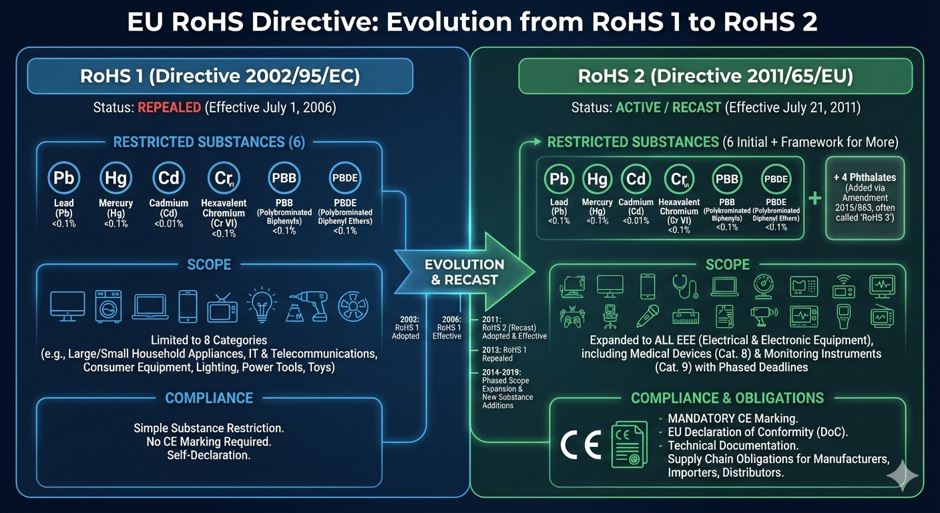
RoHS 1 was introduced by the European Union and came into force in July 2006. It was the first directive to limit hazardous substances in EEE placed on the EU market.
Restricted Substances under RoHS 1
RoHS 1 restricted six (6) substances, often referred to as RoHS 6:
- Lead (Pb)
- Mercury (Hg)
- Cadmium (Cd)
- Hexavalent Chromium (Cr⁶⁺)
- Polybrominated Biphenyls (PBB)
- Polybrominated Diphenyl Ethers (PBDE)
Scope
RoHS 1 mainly covered large categories of EEE such as:
- Household appliances
- IT and telecommunications equipment
- Consumer electronics
- Lighting equipment
Medical devices and monitoring equipment were largely excluded under RoHS 1.
RoHS 2 (Directive 2011/65/EU)
What is RoHS 2?
RoHS 2 replaced RoHS 1 and took effect in July 2011. While it retained the same substance restrictions initially, it significantly expanded the scope and compliance requirements.
Key Differences Between RoHS 1 and RoHS 2
| Aspect | RoHS 1 | RoHS 2 |
| Legal Framework | Directive 2002/95/EC | Directive 2011/65/EU |
| CE Marking | Not required | Required |
| Technical Documentation | Limited | Mandatory |
| Scope | Limited EEE categories | Almost all EEE |
| Enforcement | Less structured | Stronger market surveillance |
Expanded Scope
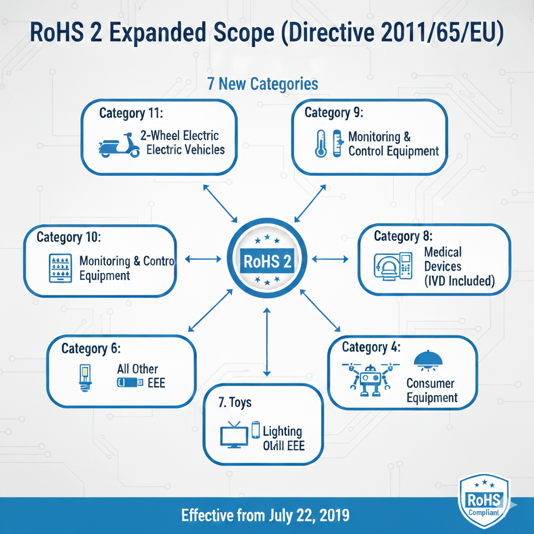
RoHS 2 introduced an open scope, meaning almost all electrical and electronic equipment are covered unless explicitly excluded. This includes:
- Medical devices
- Monitoring and control instruments
- Industrial electronics
Under RoHS 2, four additional phthalates were later added (often referred to as RoHS 10 or RoHS 3):
- DEHP
- BBP
- DBP
- DIBP
Why RoHS Compliance is Important
1. Legal Requirement
Non-compliant products cannot be legally sold in the EU and many other regions that have adopted RoHS-like regulations (e.g. China RoHS, Korea RoHS).
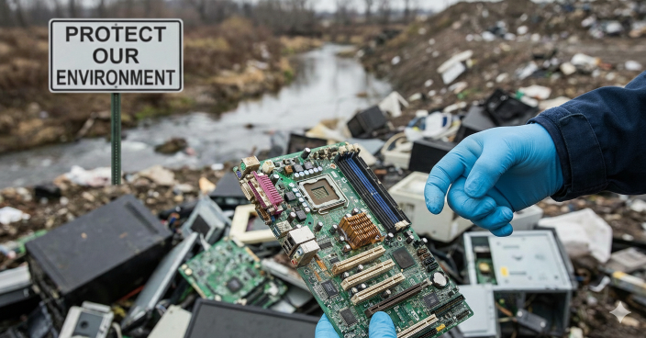
2. Environmental ProtectionRoHS reduces toxic substances entering landfills and incineration processes, lowering soil, air, and water contamination
3. Human Health & Safety
Hazardous substances restricted under RoHS such as lead and mercury pose long-term risks to workers, consumers, and recycling personnel.
4. Market Access & Customer Trust
Many multinational customers require RoHS compliance documentation as part of supplier qualification and audits.
How to Verify RoHS Compliance: Analytical Methods
Manufacturers can choose different analytical approaches depending on risk level, material type, budget, and regulatory expectations for RoHS compliance.
1. X-Ray Fluorescence (XRF) Screening
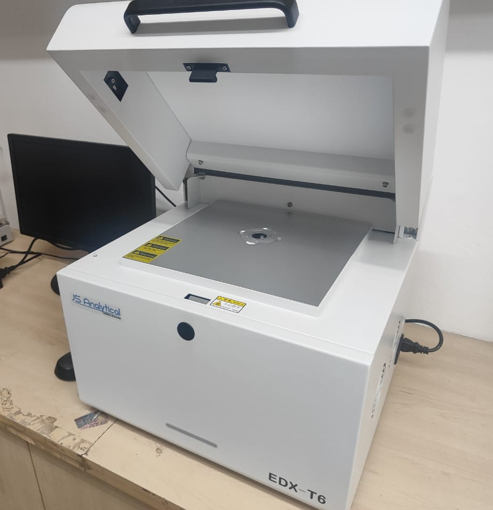
Purpose: Rapid, non-destructive screening for RoHS
Detectable Substances:
- Pb, Cd, Hg, Cr (total), Br (PBB/PBDE indicator) under RoHS
Advantages:
- Fast and non-destructive
- Minimal sample preparation
- Ideal for incoming inspection and supplier RoHS screening
Limitations:
- Cannot distinguish Cr⁶⁺ from total chromium
- Cannot identify specific brominated compounds
- Not suitable for phthalates under RoHS
Best Used For:
- Routine screening
- Supplier qualification
- Risk-based RoHS assessment
2. Wet Chemical Analysis + Instrumental Techniques

For confirmatory testing, especially when XRF results are close to limits.
a) ICP-OES / ICP-MS
Purpose: Quantitative elemental analysis
Detectable Substances:
- Pb, Cd, Hg, Cr (total)
Advantages:
- High sensitivity and accuracy
- Suitable for compliance reporting
Limitations:
- Destructive
- Requires sample digestion
b) UV-Vis Spectrophotometry (for Cr⁶⁺)
Purpose: Specific detection of hexavalent chromium
Advantages:
- Differentiates Cr⁶⁺ from Cr³⁺
- Recognized in international standards
Best Used For:
- Surface coatings
- Passivation layers
3. GC-MS for Phthalates (RoHS 10)
Purpose: Identification and quantification of restricted phthalates
Target Compounds:
- DEHP, BBP, DBP, DIBP
Advantages:
- Highly specific and sensitive
- Regulatory-accepted method
Limitations:
- Requires solvent extraction
- More complex sample preparation
Best Used For:
- Plastics, cables, flexible polymers
4. LC-MS / Py-GC-MS (Advanced Options)
Used for complex matrices or when faster screening of organic additives is required.
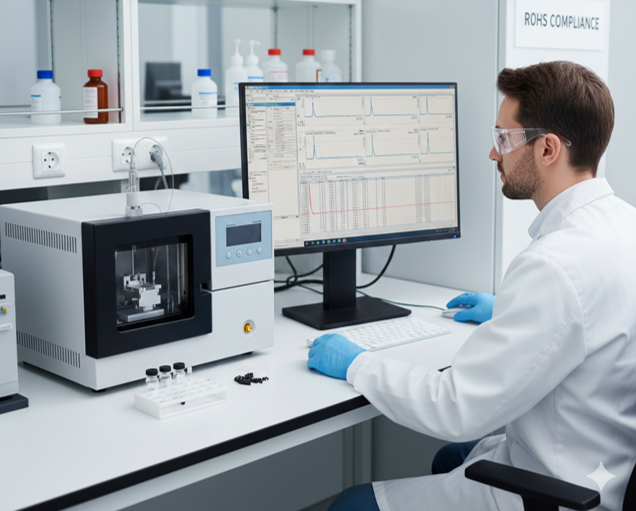
Choosing the Right Testing Strategy
A practical RoHS compliance strategy often combines:
- XRF screening for routine checks
- Targeted laboratory analysis for high-risk materials
- Supplier documentation & declarations
This risk-based approach balances cost, speed, and regulatory confidence.
Conclusion
RoHS 1 laid the foundation for restricting hazardous substances, while RoHS 2 strengthened enforcement, expanded scope, and formalized compliance requirements under RoHS. Understanding both directives—and choosing the right analytical methods—is essential for manufacturers and suppliers operating in today’s global electronics market.
By combining proper testing, documentation, and supplier control, companies can achieve sustainable RoHS compliance while protecting both human health and the environment.
